The True Cost of a New Driveway: Resin vs. Block Paving 2024
A meticulously designed driveway can increase your property's value by up to 10%, effectively adding tens of thousands of pounds to your equity before you even step through the front door. Yet, nearly 60% of homeowners completely underestimate the foundational and long-term costs associated with upgrading their off-street parking. If you are weighing up your options this year, the battle for ultimate curb appeal usually comes down to two dominant contenders: resin and block paving.
Upgrading your driveway is no longer just about having a flat surface to park the family car. In 2024, it is a statement piece, an architectural extension of your home, and a crucial element of modern property development. With the rise of electric vehicles requiring home charging points and the ever-increasing premium on off-street parking, making the right choice between a resin or block paving driveway requires a deep understanding of aesthetics, durability, and most importantly, the true financial layout.
In this comprehensive guide, we will break down the exact costs, installation processes, maintenance requirements, and longevity of both resin and block paving driveways, giving you the detailed knowledge required to make an informed investment in your property.
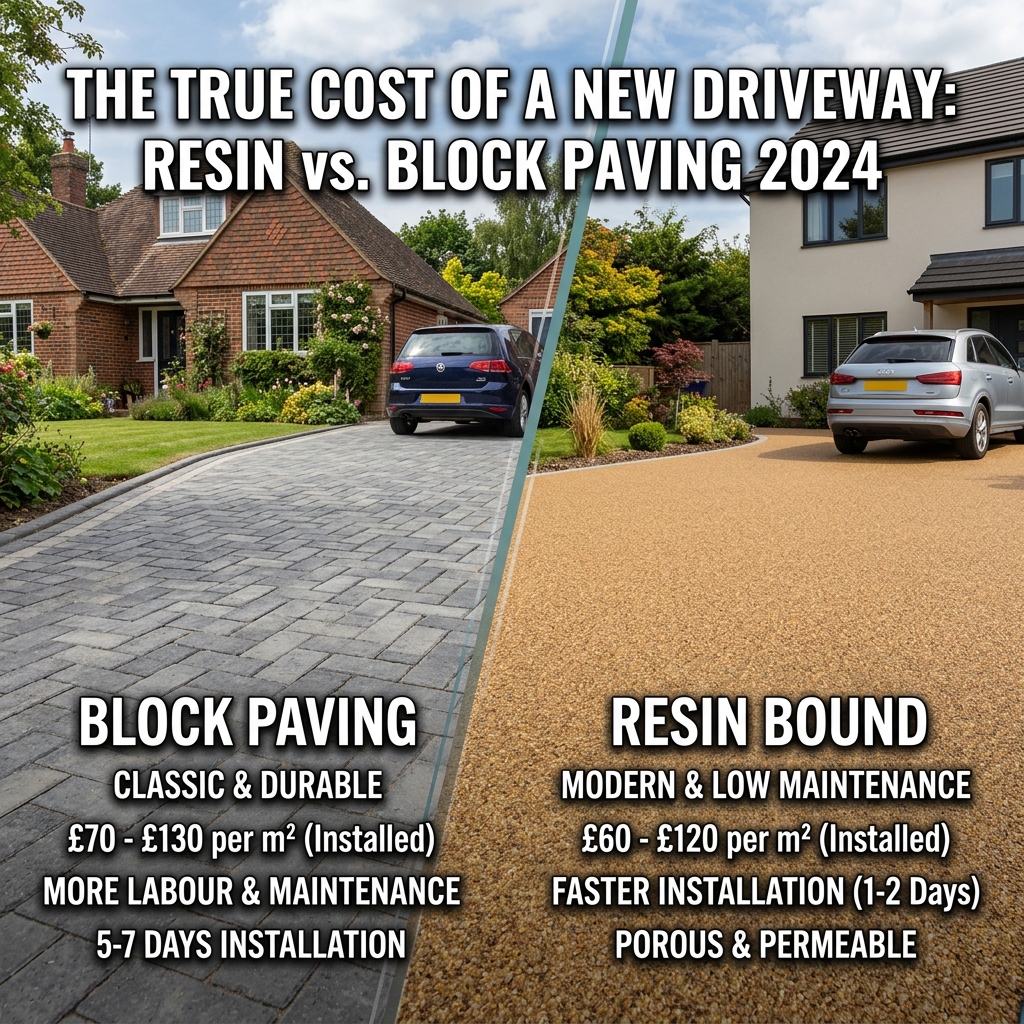
The Surprising Economics of Curb Appeal
When homeowners look to invest in their property, the focus naturally drifts toward kitchen renovations or loft conversions. However, exterior upgrades often yield an immediate return on investment. The front of your house sets the tone for everything that follows. A cracked, weed-infested concrete slab instantly detracts from a home’s value, while a pristine, sweeping resin or intricately laid block paving driveway signals a well-maintained, high-value property.
The initial cost of a driveway is only one part of the equation. To understand the true cost, we must look at the lifecycle of the materials, the necessity for ground preparation, and the ongoing maintenance over a ten to fifteen-year period. By examining the complete picture, you can avoid the trap of choosing a cheaper upfront option that ultimately drains your wallet through continuous repairs.
Understanding Block Paving: The Traditional Heavyweight
Block paving has been the go-to premium driveway surface in the UK for decades. It involves laying individual bricks or blocks—usually made of concrete or clay—in specific patterns, such as herringbone, basket weave, or stretcher bond.
The Installation Process
The reason block paving commands respect—and a substantial portion of your budget—lies in its rigorous installation process. A successful block paving driveway requires:
- Excavation: The existing surface must be dug out to a depth of at least 200mm to 250mm, depending on the soil type.
- Sub-base Installation: A robust layer of MOT Type 1 hardcore (usually 100mm to 150mm thick) is laid and compacted using a vibrating plate. This prevents the driveway from sinking under the weight of vehicles.
- Edge Restraints: Concrete edgings or kerbs are firmly set in concrete to hold the blocks tightly together.
- Sand Laying: A layer of sharp sand (around 50mm) is spread and perfectly leveled (screeded).
- Laying the Blocks: The blocks are laid by hand in the chosen pattern. This is a labor-intensive process requiring incredible precision.
- Finishing: Kiln-dried sand is brushed into the joints, and the entire surface is compacted once more to lock the blocks into place.
The True Cost of Block Paving in 2024
In 2024, the cost of block paving varies heavily based on the type of block used (concrete is cheaper than natural stone or clay) and the complexity of the pattern.
- Average Material Cost: £30 to £80 per square metre.
- Labor Cost: £150 to £250 per day, per tradesperson.
- Total Estimated Cost: For a standard 50-square-metre driveway, expect to pay between £3,500 and £5,500 fully installed.
Pros and Cons of Block Paving
Pros:
- Aesthetic Variety: Available in countless colours, shapes, and patterns.
- Repairability: If a section becomes stained by engine oil or damaged, individual blocks can be lifted and replaced without having to redo the entire driveway.
- Durability: A well-laid block driveway can easily last over 20 years.
Cons:
- Weed Growth: The joints between the blocks are notorious for harbouring moss and weeds, requiring regular maintenance.
- Sinking: If the sub-base is not adequately prepared, the driveway will inevitably develop dips and ruts where car tires sit.
- Fading: Cheaper concrete blocks can lose their colour due to UV exposure over time.
Understanding Resin Driveways: The Modern Marvel
Over the last decade, resin driveways have exploded in popularity. They offer a sleek, contemporary, and completely seamless finish. However, it is vital to distinguish between the two types of resin surfaces: Resin Bound and Resin Bonded.
Resin Bound vs. Resin Bonded
- Resin Bound: The aggregate (stones) is thoroughly mixed with clear UV-stable resin before being trowelled onto the surface. This creates a smooth, permeable finish that complies with SUDS (Sustainable Urban Drainage Systems) regulations.
- Resin Bonded: A layer of resin is spread over the base, and loose aggregate is scattered on top. It looks like loose gravel but is fixed. It is non-permeable and provides a highly textured, high-friction finish.
For most modern driveways, Resin Bound is the preferred and superior choice due to its permeability and smooth finish.
The Installation Process
Resin bound driveways require an entirely different approach to block paving:
- Base Assessment: Resin requires a monolithic (solid) base, such as tarmac or concrete. It cannot be laid directly onto soil or MOT Type 1 hardcore. If your current driveway is damaged, a new porous tarmac sub-base must be installed.
- Mixing: The chosen aggregate (a mix of sizes from 1mm to 5mm) is mixed with a two-part polyurethane resin in a specialized forced action mixer.
- Application: The sticky mixture is poured onto the base and hand-trowelled to a completely smooth, level finish, usually at a depth of 15mm to 18mm.
- Curing: The surface must be protected from rain and foot traffic for 12 to 24 hours while it cures.
The True Cost of Resin Driveways in 2024
The cost of a resin driveway heavily depends on whether you have a suitable existing base. If you can use an existing concrete or tarmac driveway, the costs plummet. If full groundwork is required, it becomes one of the most expensive options on the market.
- Cost with an Existing Base (Overlay): £60 to £90 per square metre.
- Cost with Full Groundwork: £120 to £150+ per square metre.
- Total Estimated Cost: For a standard 50-square-metre driveway requiring a new base, expect to pay between £6,000 and £8,000.
Pros and Cons of Resin Bound Driveways
Pros:
- SUDS Compliant: Resin bound is fully permeable, meaning rainwater drains naturally through the surface, preventing puddles and localized flooding.
- Low Maintenance: Because it is a solid surface, there are no joints for weeds to grow through.
- Seamless Aesthetic: It provides a highly premium, flawless look that modernizes any property instantly.
Cons:
- Initial Cost: The requirement for a solid tarmac or concrete sub-base makes it significantly more expensive if starting from scratch.
- Skill Dependent: If laid incorrectly or if it rains during installation, the resin can fail, turn cloudy, or crack.
- Irreparable Patches: Unlike block paving, if a resin driveway is badly damaged, it is very difficult to seamlessly patch a small area; you will often see the repair.
The Hidden Costs of Driveway Installations
When budgeting for your 2024 driveway project, it is critical not to look solely at the surface material. Several hidden costs can dramatically inflate your final bill.
Groundwork and Excavation
Removing 50 square metres of old concrete, clay, and soil is no small feat. It requires heavy machinery, micro-diggers, and significant manual labor. Unforeseen issues, such as discovering old tree roots, unstable ground, or a high water table, can result in extra days of labor.
Waste Removal and Skips
The volume of waste generated by digging out an old driveway is staggering. You will likely require multiple large builders’ skips or a grab lorry service to remove the spoil. In 2024, skip hire and landfill taxes have increased, meaning waste removal alone can cost anywhere from £400 to £800 depending on the scale of your project.
Drainage and SUDS Compliance
Since 2008, UK law has mandated that front gardens and driveways over 5 square metres must be permeable or have a dedicated drainage system that directs water to a porous area within your property boundary (like a lawn or border).
If you choose block paving, which is largely impermeable (unless using specific permeable blocks), you must factor in the cost of installing linear drainage channels (Aco drains) and soakaways. Resin bound surfaces, being naturally porous, bypass this requirement, which can offset some of the higher initial installation costs.
Integrating Your Driveway with Your Home's Aesthetic
A truly exceptional driveway does not exist in isolation; it must harmonise with the rest of your property. Planning your driveway alongside other exterior improvements is a hallmark of sophisticated property development.
Lighting and Security
A beautifully laid driveway deserves to be seen at night. Incorporating recessed ground lights, stylish bollard lighting, or integrated security sensors elevates the look and safety of your home. To ensure this is done safely and to the latest wiring regulations, you will need professional Electrical Services. Trying to retrofit wiring under a finished resin or block paving surface is extremely costly and damages the finish, so electrical conduit must be planned during the excavation phase.
Structural Home Improvements
Many homeowners choose to upgrade their driveways simultaneously with larger structural changes. If you are considering adding a new porch, expanding the garage, or undertaking broad Building & Extensions, it is essential to sequence the work correctly. Heavy plant machinery and scaffolding used by builders can permanently damage a newly laid driveway. Always complete major structural work before the final driveway surface is installed.
Soft Landscaping Harmony
A vast expanse of block paving or resin can look stark and uninviting if not softened by surrounding greenery. Integrating sweeping flowerbeds, structured topiary, or retaining brick walls adds texture and colour. Seamlessly blending your hardscape with beautiful front lawns is a task suited for expert Landscaping & Gardening. The right landscaping can frame your new driveway, making the entire front elevation of your home look like a premium showhouse.
Long-Term Maintenance: The 10-Year Cost Projection
To evaluate the true cost of these driveways, we must look at how much time and money you will spend maintaining them over the next decade.
Maintaining Block Paving
Block paving is high maintenance. Over 10 years, you will need to:
- Periodically apply weed killer and manually scrape out moss from the joints.
- Power wash the surface every 1 to 2 years to remove dirt, algae, and car oil.
- Re-sand the joints after every power wash, as high-pressure water blows the kiln-dried sand out.
- Optionally apply a polyurethane sealant every 3 to 5 years to protect the color and harden the sand joints. 10-Year Estimated Maintenance Cost: £500 to £1,000 (including sealants, sand, and professional cleaning equipment or services).
Maintaining Resin Driveways
Resin bound surfaces are celebrated for being low maintenance. Over 10 years, your tasks will include:
- Sweeping away autumn leaves to prevent organic matter from decomposing and clogging the porous surface.
- Occasional light jet washing (at a low pressure) to remove general surface dirt.
- Treating the rare instance of localized moss if the area is heavily shaded. 10-Year Estimated Maintenance Cost: £100 to £300 (mostly for basic cleaning solutions).
Top 5 Questions to Ask Your Driveway Contractor
Before parting with thousands of pounds, ensure you are hiring a reputable tradesperson. Ask these vital questions:
- Do you use UV-stable resin? For resin driveways, non-UV stable resin is cheaper but will turn a highly unappealing yellow/brown when exposed to sunlight over a few years. Always insist on UV-stable polyurethane resin.
- How deep will you dig the sub-base? For block paving, anything less than a 150mm sub-base on standard soil is a red flag. The driveway will sink.
- How do you handle drainage? A good contractor will immediately discuss SUDS compliance, soakaways, or the permeability of the materials being used.
- Can I see a portfolio of driveways you installed over 3 years ago? Any new driveway looks good on day one. Seeing a mature installation proves the contractor's groundwork stands the test of time and weather.
- What guarantees do you offer? Ensure you get a written guarantee covering both the materials and the labor/installation process.
Final Verdict: Which is the Better Investment in 2024?
The decision between resin and block paving ultimately depends on your budget, your property's style, and your appetite for maintenance.
If you own a period property, traditional block paving, perhaps in a rustic tumbled clay brick, offers a timeless charm that resin simply cannot match. It gives you the flexibility of cheap localized repairs and, providing you are willing to manage the weed growth, represents excellent value for money. Block paving is also the more economical choice if you are starting a driveway from a complete dirt baseline, as it does not require a structural tarmac or concrete sub-base.
Conversely, if you live in a modern home and prioritize a flawless, highly contemporary aesthetic, a resin bound driveway is the ultimate premium choice. While the initial capital outlay is higher—particularly if extensive groundwork is required—the lack of weeds, SUDS compliance, and effortless long-term maintenance make it highly attractive. It provides a luxurious "carpet-like" finish that buyers in 2024 are willing to pay a premium for.
Whichever route you choose, remember that the true cost of a driveway goes far beneath the surface. Investing deeply in correct excavation, solid sub-bases, and proper drainage is the only way to ensure that your new driveway enhances your home’s curb appeal for decades to come.
Enjoyed this article?
Need a Verified Tradesperson in Warrington?
Browse verified local professionals across Warrington & Cheshire. Compare reviews, check qualifications, and get free quotes.